Range Repair
Wolf Range Knob Replacement: Knob, Valve or a New Range?
Most Wolf range knobs pull straight off the stem, and a replacement ordered by model and serial number presses on in under a minute. If the new knob fits but the burner or oven still misbehaves, the fault sits behind the panel.
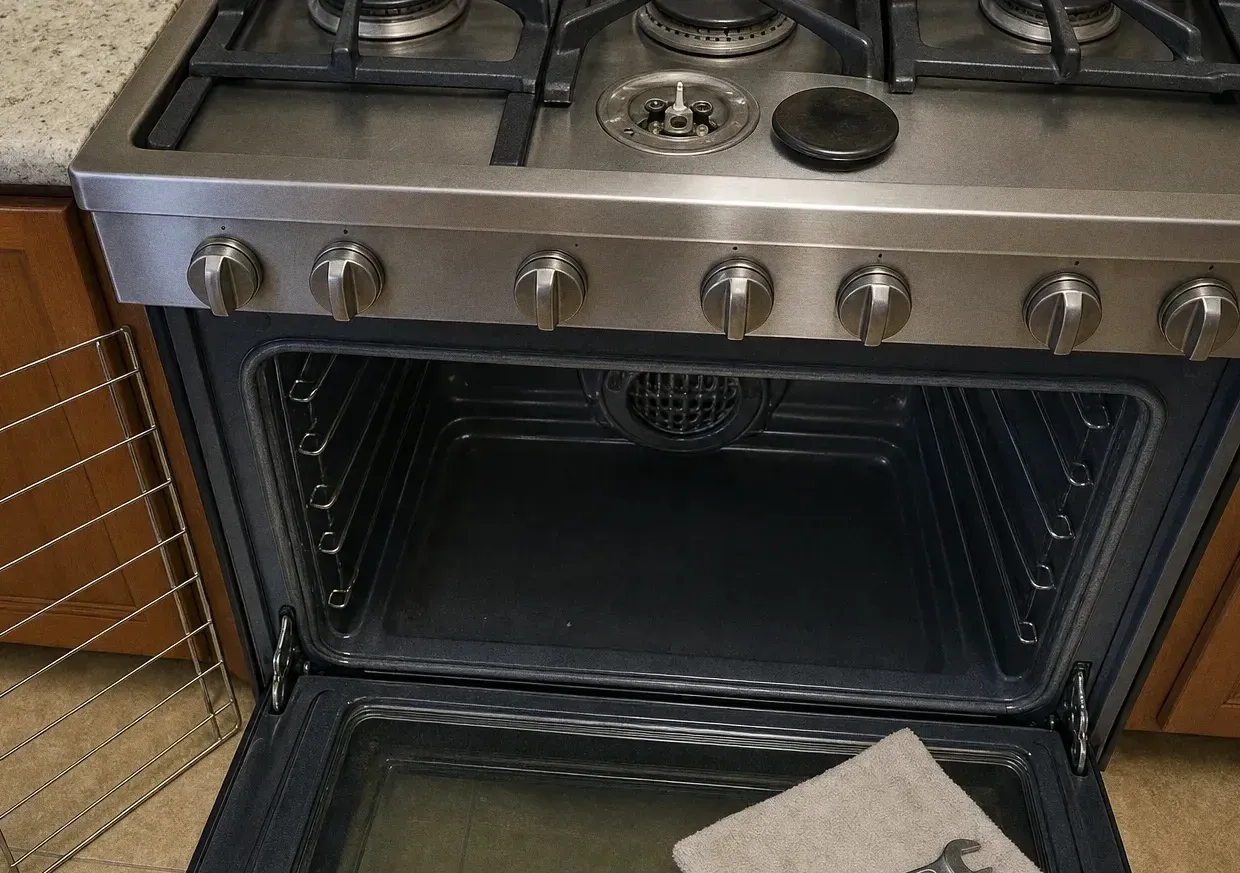
Most Wolf range knobs come off when you pull them straight toward you, and a matching replacement pushes back onto the same stem in less than a minute, so a cracked, faded or slipping knob is a part you can order and fit yourself. The catch is ordering the right one: Wolf knobs are specific to the model family and to their position on the panel, so read the serial tag before you buy. And if the knob looks fine but the burner will not light, will not stop clicking, or the oven ignores what you set, the fault lives behind the panel and a fresh knob will not change it.
That difference matters most on a built-in pro range. In a Winchester kitchen where the range was set into custom cabinetry and stone during a renovation, the cheapest good outcome is nearly always the right small part, and the costliest mistake is pulling out a sound range over a problem that sat in one valve.
Knob trouble or trouble behind the knob
Take the knob off and look at both halves of the joint. The back of a Wolf knob has a shaped socket that grips a flat on the metal stem. When that socket wears round or splits, the knob turns a little before the stem moves, sits crooked, or drops off when someone brushes past. A cracked skirt or rubbed-off markings are cosmetic, and a new knob cures them completely.
The stem tells a different story. It should stand straight and centred in its opening. If it wobbles, feels gritty, spins with no resistance or refuses to push in, you are looking at a gas valve, a burner switch or an oven selector, and that calls for a repair rather than a parts order.
| Symptom | Probable source | Your own check | Time for a technician |
|---|---|---|---|
| Knob turns before the flame changes | Worn socket in the knob | Look for rounding or a split | Only if a new knob still slips |
| Burner keeps clicking once lit | Damp spark switch, or knob not seated | Let it dry, reseat the knob, set a charbroiler knob fully at Hi | Clicking that outlasts the drying |
| Oven or griddle light flashes | Flame lost, safety lock-out | Turn the knob off, then back on | If it repeats next use |
| Griddle heats with its knob off | Possible recall condition | Compare the serial tag with recall 25-034 | Stop using it and contact Wolf Appliance |
The clicking case has its own walkthrough in our guide to a Wolf burner that clicks forever.
Ordering the knob that actually fits
Wolf model numbers spell out what you own. DF stands for a dual fuel range, GR for a gas range, IR for induction and SRT for a sealed-burner rangetop; a G, DG, C or F adds a griddle, double griddle, charbroiler or French top, and -LP on the end means propane. Each layout carries its own knob set, which is why burner, griddle and oven knobs are separate parts even on one range. On a GR, the griddle knob is scaled 100°F-450°F while the oven knob reads 150°F-500°F plus Broil, so swapping them would have you cooking by the wrong numbers.
Find the tag first. On DF, IR and GR ranges, swing the oven door open and check the lower right-hand corner of the control panel, and an SRT rangetop puts its tag in the matching spot. On the older generation, both R Series ranges and RT Series rangetops, lift out the left surface burner pan and read the tag on the burner box’s left wall. Unsure which generation you have? Sealed burners, shared grates and a stainless light button mark a GR; open burners under individual grates and a black light toggle mark the R Series.
Red knobs are the Wolf look most people know, and kits in other finishes are sold for many models. If you change colour, replace the full set at once so the panel matches.
Universal stove knobs are a poor bet. They grip the stem through adapters, cannot carry Wolf’s markings, and on a range where you push before you turn, a sloppy adapter can feel fine while the valve has not travelled properly. Marketplace lookalikes raise the same doubt unless the listing names your model family and exact position. Wolf’s own parts channel, or a dealer working from your serial number, is the safer route, and factory-approved parts keep the markings and feel of the original.
Fitting a new knob, step by step
- Turn every burner and the oven off and let the panel return to room temperature.
- On a dual fuel range, switch the breaker off before pulling an oven selector knob. Wolf’s fix for an ERR OC message on legacy dual fuel models is exactly that, followed by checking that the metal stem contacts are clean and dry and pressing the knob home firmly before restoring power, so the oven selector is more than a handle.
- Note where the old knob points at off, grip it close to the panel and pull straight out. Never lever it against the stainless with a screwdriver.
- Line up the new knob’s socket with the flat on the stem and press until it sits flush.
- Push in and turn counterclockwise to Hi; the igniter should click until the burner catches. Pushing past the lowest detent should drop the flame onto the burner’s lower simmer tier.
Two readings can look like a broken knob when nothing is wrong. SAb on a dual fuel oven knob means Sabbath mode: only Bake, Roast, Proof and Warm work, and each turn shifts the temperature by 25°F (5°C) at a random moment rather than straight away. On a gas range, a flashing oven or griddle light means the flame went out and the range locked itself out; turning that knob off and on again clears it.
Repair or replace: four things that settle it
A knob almost never decides a range’s future, but the symptom that sent you to the knob sometimes opens the bigger question.
Age
Age alone rarely rules out a Wolf, because these ranges are built to be serviced. What matters is whether parts for your generation are still easy to get.
The failing part
Typical ranges: igniter or spark module replacement $260–$620, burner valve or orifice service $260–$1,000, oven thermostat or sensor calibration $150–$680, and a control board or touch panel $530–$1,580. Each is a fraction of a new range, and the real number comes only after diagnosis.
How often it fails
One worn knob over many years is ordinary wear. The same burner losing its spark switch every few months points to a repeating cause, such as boil-overs reaching the valve area, and correcting it is part of the job. Several unrelated systems failing within a year is what justifies pricing a replacement.
What a built-in swap involves
A comparable pro range is $6,850–$19,240 for the appliance alone. The new one must also suit the cabinet opening, the hood above and the gas supply, and Wolf wants an anti-tip device fitted every time, with part number 829936 serving its current Dual Fuel and Induction ranges. Read the rating plate as well: NG or NAT means a natural gas build, LP a propane one, and a converted range gets an extra sticker near its first tag. Stone cut to one width adds work a knob or a valve never will.
One exception overrides all of this. If you own a Dual Fuel range with an infrared griddle, such as DF36450G/S/P, check its serial against recall 25-034 from November 2024. Units numbered 18517201 to 18868311 or 10006001 to 10006009 can short out after a spill and switch the griddle on unprompted. Wolf asks owners to stop using an affected range and contact Wolf Appliance, which repairs it free at home.
Getting help in Winchester
If the new knob fits but the burner, griddle or oven still misbehaves, our Wolf range repair service picks up from there, and a rangetop with the same symptoms falls under cooktop repair. A visit costs a flat $95 covering travel and the full diagnosis, and we credit it toward any repair you approve. We work across Wedgemere, Winchester Highlands, Mystic Lakes and Winchester Center; call (781) 410-4833 with the model and serial number to hand.
Still asked on the phone
Can you change the knobs on a Wolf range?
Yes, most Wolf range knobs pull straight off the stem and a matching knob presses back on without tools. Order by the model and serial number on the tag, turn everything off first, and on a dual fuel range switch the breaker off before pulling an oven selector knob.
Are Wolf knobs interchangeable?
Only within the same model family and the same spot on the panel. Burner, griddle and oven knobs are separate parts with different markings, and a gas range knob is not the same part as a dual fuel or older R Series knob, so give the seller your full model and serial number.
Are replacement stove knobs universal?
No, universal knobs depend on plastic adapters and carry generic markings, so they rarely suit a Wolf. On a range where you push the knob in before turning it, a loose adapter can feel normal while the valve underneath has not moved as it should.
What does Wolf range knob replacement cost?
The knob itself is a part you can fit yourself, so the job costs only the part. If the trouble turns out to be behind the knob, typical ranges are $260–$620 for an igniter or spark module and $260–$1,000 for burner valve service, with the exact figure given after diagnosis on a $95 visit.
Where can I buy Wolf replacement knobs?
Buy them through Wolf's own parts channel or an appliance-parts dealer who looks the part up from your serial number. Lookalike listings on big marketplaces may not match your model family or knob position, so confirm the listing names both before you order.