Range Repair
Wolf Oven Smells Like Gas: Leak, Burn-Off or Late Ignition
If your oven smells like a gas leak, with a strong rotten-egg odor, leave the house without touching switches or flames and call the gas utility or 911 from outside. A faint whiff that fades within a second or two of the burner lighting is usually normal.
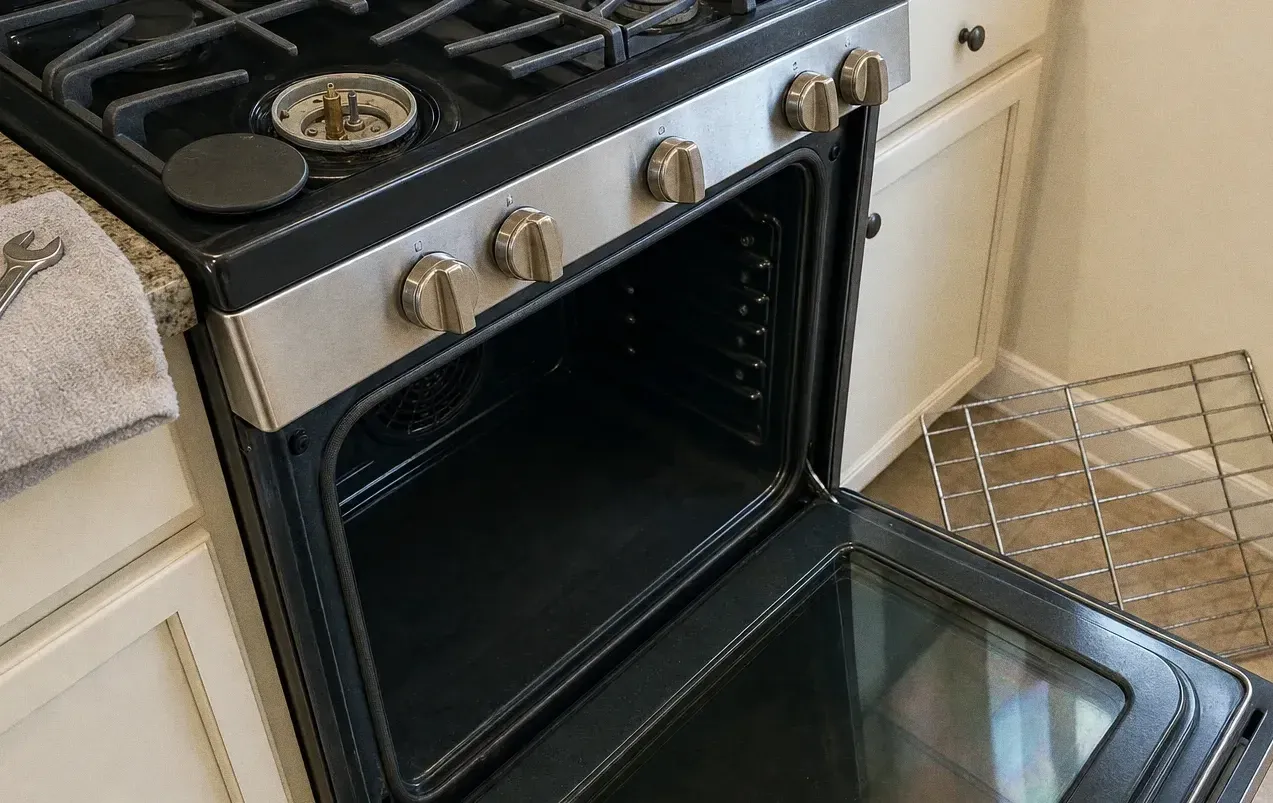
A strong rotten-egg smell from your oven means you should treat it as a gas leak: stop cooking, leave every knob and switch as it is, get everyone outside, and call the gas utility’s emergency line or 911 once you are away from the house. A faint odor that lasts only a second or two as the oven burner lights, then vanishes, is usually normal on a gas oven. The sections below explain how to tell the cases in between apart.
This matters more on a pro-style range. An all-gas Wolf range feeds several open burners plus one or two oven burners from a single supply, so there are more valves and fittings where a small leak can begin. Many Winchester kitchens also sit in older houses where the line to the range was moved during a remodel, leaving joints behind the appliance that nobody has inspected in years.
If the smell is strong, act in the first minute
Do not hunt for the source. Do not switch the oven off at its panel, flip a light, unplug anything or press a doorbell, because each can throw a tiny spark. Do not strike a match to see better, and do not make a call until you are outdoors. Gather people and pets and walk far enough away that you can no longer smell gas.
Then phone the gas company’s emergency number or 911. Utilities treat an odor report as an emergency and send someone with an instrument that finds a leak far faster than a nose can. Stay out until that person says the house is safe. If the leak is traced to the range and the appliance valve is closed, an appliance technician takes over from there.
Smells that are usually not a leak
The most common false alarm is burn-off on a new oven. The first few times a fresh cavity heats, insulation binders and the protective oil on the metal cook away, giving a hot, chemical smell and sometimes a thin haze. Running the empty oven hot for an hour with the windows open usually clears it.
Food is the next suspect. Sugar, cheese or grease on the oven floor or burner cover smokes and smells sharp every time the oven heats, and so does residue loosened by a self-clean cycle.
The real test is the character of the smell. Natural gas is odorless on its own, so utilities add a sulfur compound, and that rotten-egg or skunk note is unlike anything cooking produces. Burnt, smoky or hot-plastic smells are probably not gas. Sulfur, assume it is.
Which Wolf ovens can leak gas at all
Wolf wall ovens are electric, and so are the ovens in Wolf dual-fuel ranges, where only the burners on top run on gas. If the smell seems to come from one of those, the gas source, if any, is the rangetop above or another gas appliance nearby. An all-gas Wolf range is different: its oven has a bake burner and usually a broil burner, each with a safety valve and an ignition part, and those are where a genuine oven-side gas smell tends to start.
A whiff at ignition: normal or a warning
Gas ovens light the bake burner with either a hot surface igniter, which must glow before the valve opens, or a spark electrode. Either way, gas moves a moment before the flame takes hold, so a faint odor at startup is expected. A delay is what to watch for. An aging igniter draws less current and opens the valve late, or a worn electrode sparks weakly, and a bigger puff gathers before it catches. You may hear a soft boom or smell gas for ten or fifteen seconds each time the oven cycles on.
Other signs of a fault: the smell builds the longer the oven runs, it appears with the oven off, or the flames are lazy and yellow instead of crisp and blue. Yellow flames suggest poor combustion, which can produce carbon monoxide, a gas you cannot smell. Keep a working CO alarm on the kitchen floor.
For a smell from the rangetop, check the knobs first; one nudged past off can release gas without sparking. If a burner clicks without lighting, see our write-up on a Wolf burner that clicks forever.
What the repair visit checks
Once the utility has cleared the house, or the smell is faint and no knob was left open, a technician follows the gas path in order: a leak test at the shutoff valve, flexible connector and pressure regulator, then the manifold and each burner valve, using an electronic detector and bubble solution on every joint. Next comes the oven: igniter current draw, how quickly the safety valve opens, the burner and its orifice, and the flame once lit. A carbon monoxide reading at the oven vent finishes the check.
A leak in the house piping upstream of the appliance valve belongs to a licensed gas fitter. Our range repair service handles the appliance side, from the connector forward.
Typical costs and booking a visit
The visit starts with a flat $95 fee for the trip and diagnosis, taken off the bill when you go ahead with the repair. Replacing a weak igniter or spark module typically runs $260–$620, and servicing or replacing a burner valve or orifice typically runs $260–$1,000. You get a firm price once the fault is found.
To book, call (781) 410-4833 once you are certain the house is safe. If you smell gas strongly right now, call the gas utility first, from outside.
Still asked on the phone
Is it normal for a gas oven to smell like gas when it turns on?
A brief, faint odor for a moment as the bake burner lights is normal on many gas ovens, because a little gas flows before the flame catches. A smell that lingers, grows stronger, or comes with a soft boom at ignition is not normal and needs a technician.
What does a gas leak from an oven smell like?
Leaking natural gas smells like rotten eggs, sulfur or skunk, because the utility adds an odorant to a fuel that would otherwise have no smell. Burn-off from a new oven smells hot and chemical, and spilled food smells smoky or burnt rather than sulfurous.
Can a Wolf wall oven leak gas?
No, Wolf wall ovens run on electricity, so a gas smell near one is coming from something else, such as a rangetop or cooktop nearby, or it is not gas at all. Treat any sulfur smell as a leak until someone with a detector says otherwise.
Should I shut the gas valve behind the range myself?
Only when the smell is faint and the valve is easy to reach without sliding the range out or flipping any switch. With a strong odor, skip the valve entirely, get everyone outside, and let the gas utility shut things off.
Does carbon monoxide smell like gas?
No, carbon monoxide has no smell, so the absence of a gas odor does not prove the air is safe. Any home with a gas range should have a working carbon monoxide alarm, and lazy yellow flames in the oven are a reason to have combustion checked.